29 August 2026 · 5 min read
Six years of client work, read in one sitting
I exported every review from my Fiverr profile and read them end to end. The average rating turned out to be the least interesting number in the file.
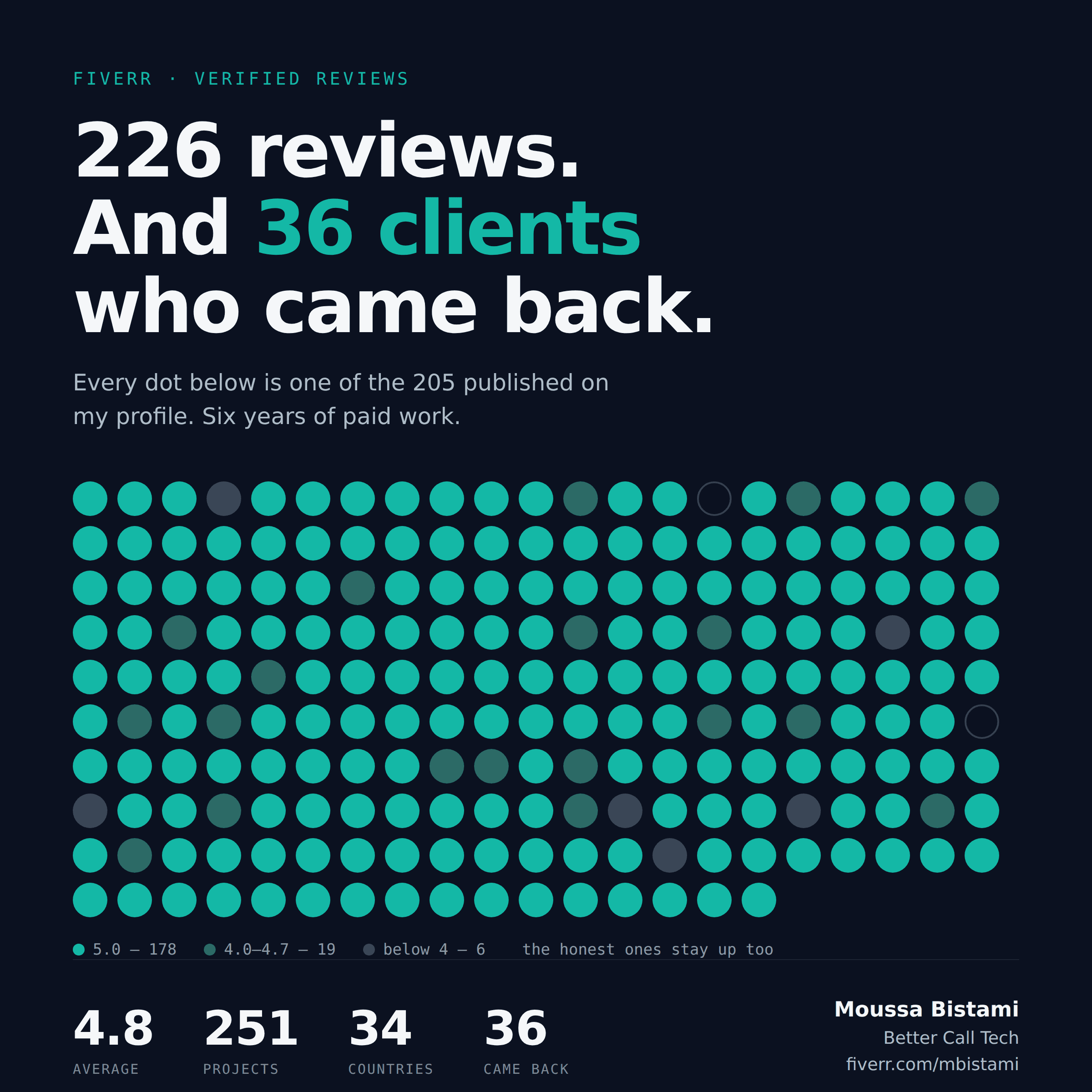
I have been taking client work for six years and I had never read the reviews in one sitting. You see them arrive one at a time, usually while you are already halfway into the next project, and then they scroll away. Last week I exported all of them into a spreadsheet and actually sat with the file.
226 reviews. 4.8 average. 251 completed projects. Clients in 34 countries.
The average is the number people quote, and it is the least interesting one in the file.
What the average hides
Almost every established freelancer has a 4.8. The rating scale is compressed at the top: anything below a 4.7 reads as a warning, so the number stops distinguishing anyone from anyone. Of the 205 reviews published on my profile, 178 are a flat five. That tells you the work was acceptable. It does not tell you it was worth paying for twice.
The number that does is 36.
The 36
Thirty-six clients came back for a second project. One came back six times. Three others came back five. A Canadian accounting firm ordered three times across five months and left this after the longest of the three:
Best interaction I've had on Fiverr to date. Will absolutely purchase again and would not hesitate to recommend to anyone considering working with him.
People do not repeat-buy politeness. They repeat-buy relief — the specific relief of not having to explain the whole thing again, not having to check whether it was really done, not having to manage you. A second order is the only review that costs the client something to write.
If I could keep one metric from six years, it would be that one.
Two words, or two hundred
The reviews split into two clean shapes.
Most are short — 65 of them are six words or fewer. "Very good work!" "Amazing as usual." "Great job very transparent." Those come from projects that went exactly as scoped — the client got what they expected, and there is nothing to write about a thing that simply worked.
Then there are 29 that run past forty words, and a dozen past sixty, and they have something in common: every one of them came from someone who was nervous. You can hear it in the opening line. I was hesitant hiring a developer from Fiverr, but I'm so glad I did. One client described a bot that arrived riddled with errors from a previous developer and what it took to turn it into something that ran. Another walked through the documentation, the bug-free code, the patience of explaining the technical parts.
Nobody writes a hundred and sixty words about a freelancer because the work was fine. They write it because they had braced for something to go wrong and it did not. The long reviews are not a measure of quality — they are a measure of how much risk the client felt they were taking when they clicked buy.
The six that stay up
Six reviews sit below four stars, and two orders were cancelled outright. They stay on the profile.
The worst one is fair. Basic API changes, a two-week delivery date, and then near-silence from me for most of it — the client had handed over login details for their site and heard almost nothing back. That is not a quality problem. That is a communication problem, and reading it again a year later still stings in the correct way.
Those reviews changed how I work more than any of the 178 fives did. Every one of them is about scope drifting or updates going quiet, never about code that did not run. So the fixes were not technical: shorter scopes, a written plan before the first commit, an update even on the days when the update is "still on it, here is where I am."
A profile with no bad reviews tells you the person is either new or careful about which projects they accept. I would rather show the dents.
Where the work came from
The United States, 69 reviews. France, 28. Canada, 15. The United Kingdom, 14. Germany, 9. Then the Netherlands, Mexico, Sweden, Australia, Saudi Arabia, Indonesia, Belize, and twenty-odd more — all of it from a desk in Morocco.
The work itself moved as much as the map did. It started with Discord bots and small websites. It became dashboards, Shopify storefronts, mobile apps on the App Store. Lately most of it is AI automation: assistants that answer in two languages, workflows that connect the tools a company already pays for, systems that quietly do the thing a person used to do by hand every Tuesday.
The through-line was never the stack. It was being the person who finishes.
What I would tell someone two years in
It will not feel like a career while it is happening. It feels like one message, one scope, one delivery, then the next one, for years. The compounding is real but it is invisible from inside — you cannot feel a body of work, you can only count it.
So count it, once. Export the whole thing and read it end to end. You will find the story is not the one you tell in the bio, and the number that matters is not the one at the top of the page.
Then go back to work. There is a message waiting.
Working on something similar? Book a call.